
Artificial Intelligence
AI Audit Tools: How Smart Tech Is Transforming Compliance
AI-powered audit software is transforming compliance, helping businesses reduce risk, streamline audits, and improve performance in real time.
 Jack Hughes
The school summer holidays are not a surprise. The date is in the calendar. The footfall spike is predictable. The drop in staff availability, the longer queues, the noise, the children, the shorter customer tolerance for anything going wrong: all of it is foreseeable.
And yet, every August, retail operators find themselves firefighting problems they could have prepared for in May.
This is the window. Here is how to use it.
Customer satisfaction scores fall during the summer holidays. This is consistent across retail sectors, and the reasons are structural, not random.
Footfall increases while staffing often decreases, because school holidays mean more customers and fewer available staff at the same time. Queues build. Customers who were willing to browse for fifteen minutes on a quiet Wednesday in March are not willing to wait ten minutes at a till when they have three children with them in August.
The physical environment becomes harder to manage. Changing rooms fill up. Queues spill into aisles. Trolleys block access. Noise levels rise. Staff are stretched, and their ability to deliver the kind of attentive, friendly service that generates positive feedback is reduced not because of attitude, but because of volume.
None of this is the fault of any individual store or team. It is the predictable outcome of insufficient preparation for a foreseeable surge.
When customer satisfaction scores drop in July and August, the instinct is sometimes to write it off. “It is just a busy period.” “Customers expect queues in summer.” “There is nothing we can do.”
Each of those is partially true and mostly wrong.
Customers do expect it to be busier. They do not expect it to be chaotic. The ones who leave negative feedback in peak periods are telling you something specific: that the experience fell below a threshold they were willing to accept, even accounting for the conditions.
The feedback from these periods is some of the most operationally valuable you will receive all year, because it is stress-tested. It tells you which locations break down under pressure, which processes fail at volume, and where the gap between your intended customer experience and the delivered one is widest.
The businesses that read that feedback carefully and act on it are the ones that improve year on year. The businesses that wait for it to arrive and then explain it away are the ones that have the same problems in 2026 that they had in 2024.
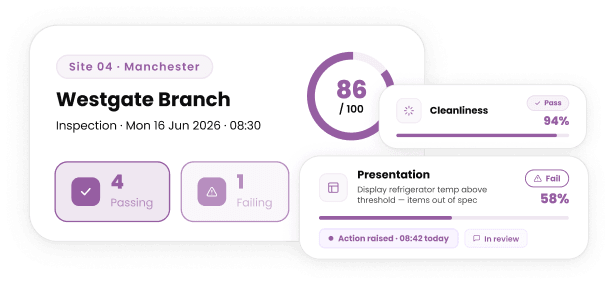
Audit your peak-period processes before they are under pressure. Walk your highest-traffic locations and ask: what breaks when this store is at 150% of normal capacity? Where do queues form? Where does the till process slow down? Where does the team lose control of the floor? The answers you get in June are easier to act on than the answers you get from a one-star review in August.
Set specific standards for peak-period operations and communicate them clearly. If till queues above a certain length should trigger a defined response (opening a second lane, calling additional staff to the floor, direct queue management), that process needs to be written down, trained, and practised before the surge. Not improvised on the day.
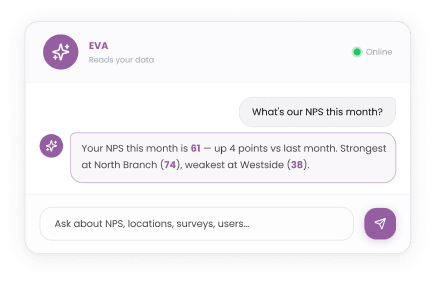
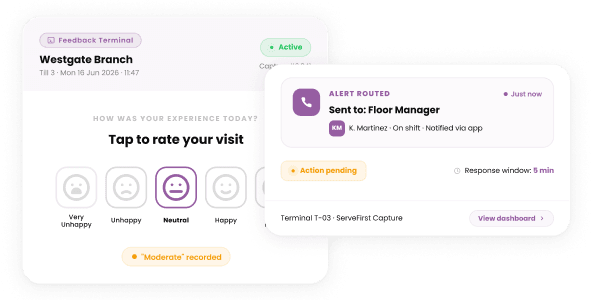
Give store managers the data they need to respond in real time. A manager who knows at 11 am on a Saturday that their customer satisfaction score from the morning session is below the threshold has a chance to identify what is going wrong and correct it. A manager who finds out via a weekly report the following Friday does not.
Staff for the peak, not for the average. The commercial case for adequate peak staffing is straightforward: under-staffed peak periods generate negative feedback that suppresses return visits and damages reputation. The cost of that damage almost always exceeds the cost of the additional hours. Run the numbers before you set your summer rota.
Train for the specific pressures of the period. A member of staff who is excellent on a quiet Tuesday may not know how to handle a frustrated parent with two children in tow who has been waiting at a fitting room for twenty minutes. Peak-period customer interactions require different skills: de-escalation, speed, clarity, and the confidence to ask a colleague for help. That should be trained before the holidays start.
Even well-prepared operations generate more complaints in peak periods. The goal is not to eliminate negative feedback: it is to reduce the volume of avoidable complaints and respond effectively to the ones that occur.
Responding well to peak-period feedback means three things.
Speed matters. A customer who left a negative review on Tuesday and gets a response on Thursday feels heard. A customer who waits ten days feels ignored. In peak periods, when the volume of feedback increases, your response process needs to scale with it.
The response is not the fix. A well-crafted reply to a negative review is not a resolution. The resolution is the operational change that prevents the same thing from happening to the next customer. If your fitting room wait times are generating consistent feedback, the response to each review is less important than fixing the fitting room process.
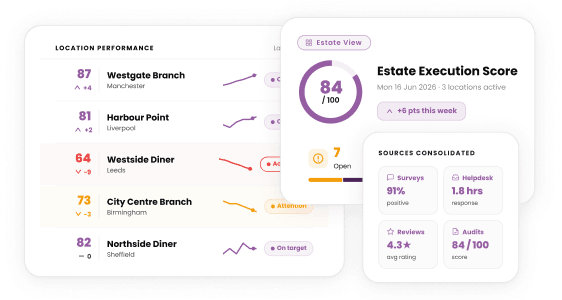
Look for patterns, not just incidents. Individual complaints are anecdotes. Patterns are intelligence. If six locations are receiving similar feedback about queue management in the same two-week window, that is a systemic signal. It needs a systemic response: a cross-location review, a process change, a rapid training update. Not six separate apology emails.
There is a version of this that goes beyond damage limitation.
A retail operator that consistently delivers a better-than-expected experience during the summer holidays, when customers are primed to be disappointed, creates something that is genuinely difficult for competitors to replicate: a reputation for reliability under pressure.
That reputation is built location by location, shift by shift. It comes from managers who have clear standards to follow, teams who know what to do when the floor gets busy, and leadership who can see in real time which locations are holding up and which need support.
Prepare now. The traffic is coming either way. The question is whether you meet it with a plan or a problem.
Serve First helps retail operators capture customer signals in real time, act on them before they become reviews, and build the operational consistency that holds up when it matters most.
AI-powered audit software is transforming compliance, helping businesses reduce risk, streamline audits, and improve performance in real time.

Price may win a sale, but customer experience builds loyalty. Discover why leading brands focus on experience over competing on cost.

Every event has unique risks. Discover how compliance processes can adapt to meet Martyn’s Law requirements across changing venues and audiences.
“Serve First has transformed how we manage customer experience, giving us clear insights that have driven tangible results for our business.”

Senior Customer Experience & Training Specialist, The Body Shop