See it on your sites
A personalised walkthrough with your locations, teams and data.
 Conrad Wilson
You’ve probably got more feedback than ever. Surveys. Reviews. Support tickets. Social comments. Maybe even a smiley terminal by the exit. But most teams don’t have a feedback problem. They’ve got an action problem.
Because customers don’t care that you measured their experience. They care that you fixed it. Fast. And in a way that stops the same issue happening again tomorrow.
That’s where CSAT comes in.
Used well, your CSAT score gives you a clean, quick read on how customers feel right now. Then, when you connect it to the drivers behind the score (and give teams a simple way to act), CSAT stops being a number on a slide and starts becoming a real lever for better customer experience.
Let’s make that happen.
So, what is a CSAT score? CSAT stands for Customer Satisfaction Score. It’s usually a single question asked right after an interaction, like:
Customers answer using a scale (often 1–5, 1–10, or smiley faces). You then track the percentage of customers who say they’re satisfied.
CSAT still matters because it’s immediate. It’s tied to real moments. And it’s easy to understand across the business, from the frontline to the boardroom.
It also fits how modern customers behave. Expectations are high, patience is low, and one bad experience can push people to switch.
CSAT shines when you want to measure satisfaction with a specific moment, such as:
If your experience happens in “moments”, CSAT gives you a fast signal.
CSAT can also lie to you, if you let it, so watch out for:
A rating without a reason is just a mood ring. If you want CSAT to help you improve, you need a score and a story.
Let’s get practical. CSAT score calculation is simple, but it needs consistency. Most businesses define ‘satisfied’ as the top end of the scale:
Then you use the standard formula:
CSAT score = (Number of satisfied responses ÷ Total responses) × 100
Here’s an example:
If 80 customers respond and 60 are satisfied, your CSAT is:
60 ÷ 80 = 0.75
0.75 × 100 = 75% CSAT
Simple, clean, and easy to trend.
Pick your definition and stick to it. If you change your scoring rules every quarter, you’ll never know whether you’re improving or just moving the goalposts.
If you only get a handful of responses, one bad day can tank your CSAT score. If you only ask your happiest customers, the score floats. If you ask at the wrong moment, you measure frustration, not satisfaction. And if customers believe their feedback disappears into a black hole, they stop responding.
Gartner research highlights that customers are more likely to give feedback when the invitation is timely and concise, and when you show how feedback is used.
The fix is straightforward:
A rising CSAT score feels good. But it’s not the end game. Better experiences are the goal. So here’s the mindset shift you should make:
Stop managing CSAT. Start managing the drivers of CSAT. Because the score is an output. The drivers are the inputs. Pillars like ‘Time and Effort’ and ‘Resolution’ map directly to what your customers feel day to day. When effort is high and resolution is slow, satisfaction drops.
Pair CSAT with operational signals that explain it, such as:
This is where CSAT becomes useful. You stop asking ‘Why did our score drop?’ and start asking ‘What changed in the operation that customers can feel?’
If you want to improve your CSAT score, focus on a handful of drivers that show up again and again across industries:
Here’s how you turn those drivers into action.
Customer effort is often the quickest route to CSAT improvement, because effort is what customers remember. Cut steps. Remove handoffs. Give clear updates. Make it easy to do the next thing. In customer service, effort usually comes from:
If you fix that, CSAT climbs.
Things will go wrong. That’s not the test. The test is how fast you recover. The organisations that improve CSAT consistently are the ones that spot issues early, assign ownership immediately, fix the root cause, not just the symptom, and close the loop with the customer.
Multi-site businesses often have pockets of pain. One store. One region. One shift. One manager. One process that never quite works. So don’t just track CSAT overall. Segment it by:
That’s where the truth lives.
Let’s make this feel real. Here are a few examples you can picture in your operation.
A customer finishes shopping. They hit a long queue. They leave annoyed. If you only measure CSAT in a monthly survey, you’ll find out too late.
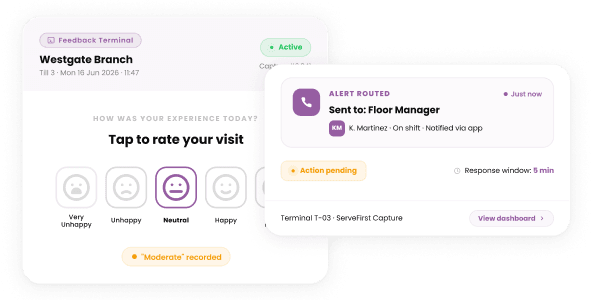
But if you capture in-the-moment feedback at the exit, you can see queue frustration as it happens, assign it to the duty manager, and trigger a quick fix:
That’s how you protect CSAT in real time.
If you want a practical way to capture fast, honest, in-the-moment feedback in physical spaces, Serve First’s feedback terminals are built for exactly that.
Guests won’t always complain in the moment. They’ll smile, leave, then write a review. So you need to catch dissatisfaction early.
If CSAT dips on ‘speed of service’ on weekends, you don’t need a six-week project. You need one focused fix:
Then track the shift-level change and watch the score move.
In facilities management, customers often experience standards as the basics:
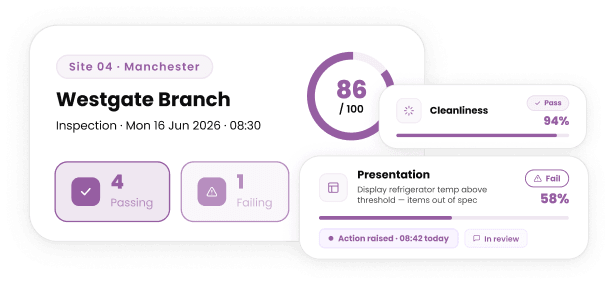
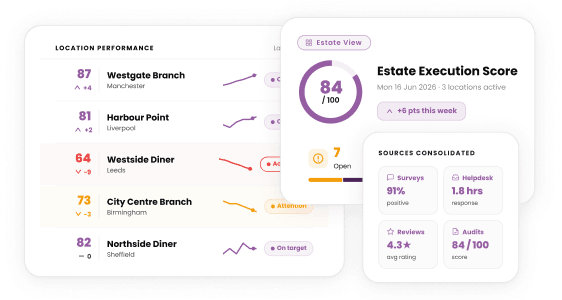
If audit scores dip and CSAT drops alongside it, that’s not two problems. It’s one. The win is connecting standards data and customer feedback into one view, so teams stop bouncing between systems and start acting on what matters. Serve First’s customer insights approach is designed for that kind of connected view.
Here’s the big problem most CX leaders face: You’ve got plenty of data, but not enough clarity. Dashboards don’t fix experiences. People do. So your measurement system needs to do three things well:
That’s the difference between ‘we track CSAT’ and ‘we improve CSAT’.
It’s also why AI is showing up more and more in CX measurement. When AI can read the themes in feedback, highlight the drivers, and recommend next actions, you stop spending hours analysing and start spending time improving.
If you’re in B2B, CSAT gets trickier. You’ve got fewer customers, higher revenue per account, and longer relationships. Satisfaction can look stable, right up until it isn’t.
That’s why B2B measurement needs structure. Client Connect is built to give you that structure, without turning measurement into admin. It helps you:
Instead of every QBR being a one-off scramble, you build a repeatable rhythm:
That makes satisfaction measurable, not guesswork.
In B2B, a single unhappy stakeholder can become a revenue risk. Client Connect is designed to help you spot that early with account-level trends and alerts, so you can intervene while the relationship is still recoverable.
If you want momentum quickly, here’s a simple plan you can run in 30 days.
CSAT is one of the simplest CX metrics you can use. But it only works when it drives action. So if you want a better CSAT score, keep it simple:
That’s how you turn ‘feedback’ into better experiences.
And if you want to see what it looks like when CSAT measurement is built for action, not analysis, Client Connect is a strong place to start.
A ‘good’ CSAT score depends on your industry, your response options, and how you define ‘satisfied’ in your customer surveys. In most sectors, scores above 75-80% are considered strong, but the real benchmark is your own trend.
What matters more than the number is whether your customer support teams are improving key drivers like speed, clarity, and consistency. Track your CSAT score alongside average resolution time and repeat contacts so you can see whether rising satisfaction links to better customer outcomes, not just better scoring habits.
CSAT measures satisfaction with a specific customer interaction. The Net Promoter Score measures likelihood to recommend, which links closely to customer loyalty and long-term brand advocacy. CES (Customer Effort Score) measures how easy it was to get help.
You should use them together because they answer different questions across the customer journey:
When you combine them, you get a clearer view of overall customer sentiment, not just a single metric.
If response rates are low, simplify your customer surveys and trigger them immediately after key customer support interactions. The shorter and more relevant the ask, the higher the completion rate.
You should also close your feedback loops. When customers see that their feedback improves the user experience, they’re more likely to respond next time. Concise surveys connected to visible action improve participation rates, so focus on timing, clarity, and relevance rather than sending more surveys.
Use in-the-moment feedback tools that take seconds, not minutes. Simple tap-based response options at exits, kiosks, or service desks allow customers to rate their experience without disrupting the flow of the visit.
This works especially well in high-traffic environments where customer interaction happens quickly. The key is frictionless capture and fast routing to the right team so feedback becomes action. That way, you protect the User experience instead of interrupting it.
If CSAT feels like a performance weapon, it will be manipulated. Keep the focus on improvement, not punishment. Avoid linking individual pay directly to CSAT score. Use randomised sampling and monitor anomalies. Then pair your CSAT score with operational measures like average resolution time, repeat contacts, and complaint categories.
When customer support teams see CSAT as a learning tool that improves customer outcomes, you reduce the risk of distortion and increase genuine accountability.
Direct benchmarking is difficult because every business defines ‘satisfied’ differently. Instead of chasing a generic number, compare trends. Look at publicly visible signals that influence customer loyalty and brand advocacy, such as review sentiment, recurring complaint themes, and response speed.
Then benchmark your internal CSAT drivers against industry standards for customer support and service quality. This gives you context without relying on unreliable comparisons.
Measure CSAT at key moments in the customer journey, not on a fixed weekly or monthly cycle. Trigger short customer surveys after moments that shape customer loyalty, such as:
Rotate sampling to protect your response rate and align measurement to evolving customer expectations. The right frequency feels relevant, not repetitive.
In B2B environments, small changes in customer sentiment can signal rising customer churn before contracts are lost.
Track CSAT score by account, stakeholder group, and key milestones like onboarding, service escalations, and renewals. Then connect satisfaction trends to revenue, upsell activity, and contract health.
If you see a dip in CSAT score combined with rising issues or delays in customer outcomes, that’s an early warning for weaker customer retention. Account-level tracking matters far more than overall averages.
AI helps you move beyond scoring into insight. It can analyse open-text comments from customer support Interactions, detect patterns in customer sentiment, and connect themes to performance data like average resolution time.
The goal isn’t more dashboards. It’s faster prioritisation, clearer ownership, and smarter action across your customer support operation. AI summarises what matters so teams spend less time analysing and more time improving the user experience.
If your CSAT score rises while complaints increase, something is misaligned. You may be:
Compare CSAT trends with complaint categories, operational data, and wider customer sentiment signals. If complaints are rising despite a stable score, it may indicate shifting customer expectations or a breakdown in your feedback loops. The answer isn’t to chase the number. It’s to reconnect insight to real customer outcomes.

Senior Customer Experience & Training Specialist, The Body Shop


